
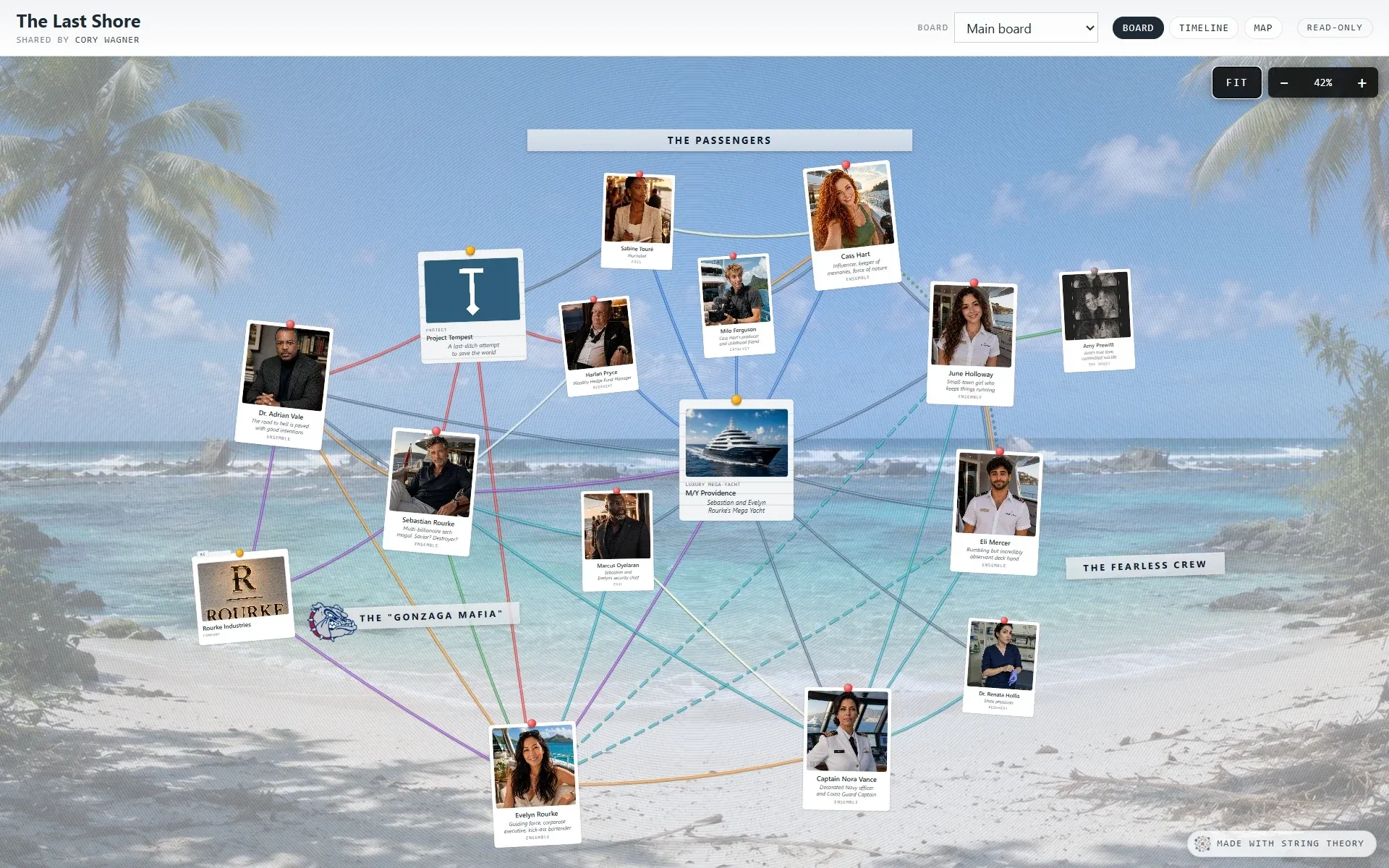
The corkboard, digitized
Every writing room, and half the novelists you admire, works the same wall: scenes on index cards, photos of the cast, and string between them. The wall has survived a century of better tools because structure is spatial. You have to see that the middle sags, that a character vanishes for eighty pages, that the reveal has nothing set up underneath it. The Story template is that wall, for anyone writing a novel, a screenplay, a series, or a graphic novel.
Characters carry the craft questions
A character card doesn’t ask for a favorite color. It asks what they want, their flaw, how they change, and how they talk, because those are the questions that decide whether a scene works. The roles speak the writer’s language too: Protagonist, Antagonist, Love interest, Foil, Narrator. Relationships drive plots, so a string can say loves and then say what kind: requited, unrequited, complicated, or unspoken. Those are four different novels.
Structure is a string you can see
One scene results in the next. That is the old “but/therefore, never and-then” rule, drawn on the wall instead of held in your head. A detail in chapter two foreshadows the payoff in chapter nine, and now that setup is a physical string. Cut the payoff in a later draft and the dangling string tells you what else just broke. Two scenes can echo each other, and an object can symbolize a theme. Your outline stops being a document you reread and becomes a wall you look at.
Nothing you cut is lost
Everything on the board carries a Canon status. Canon, Tentative, and Cut are the suggestions, but the field accepts your own words, and at least one real chronology on this template runs its own vocabulary. The scene you cut in draft three stays on the board, marked honestly, because draft five usually wants it back. The story’s two clocks stay separate as well. The order in which events happened and the order in which the reader learns them are both yours to hold.
Your first board in 15 minutes
- Create a project and pick Story.
- Add your protagonist and antagonist, and fill in what they want. Just that one field for now.
- Add three scene cards: the opening, the midpoint, and the ending you’re aiming at.
- String them with results in. If a string feels like “and then”, you’ve found your first structural problem.
- Add one foreshadows string from an early scene to a late one.
- Open the Timeline and put the scenes in story order. Now you have a spine.
What it isn’t
The Story template is for writing fiction. Analyzing a book that already exists, for a class or a book club, is the job of its sibling, the Literary Analysis template, which speaks in evidence and interpretation instead of drafts and cuts. Nothing here writes for you: there are no generated plots and no AI prose. It holds the story so your head doesn’t have to.