
Story’s opposite number
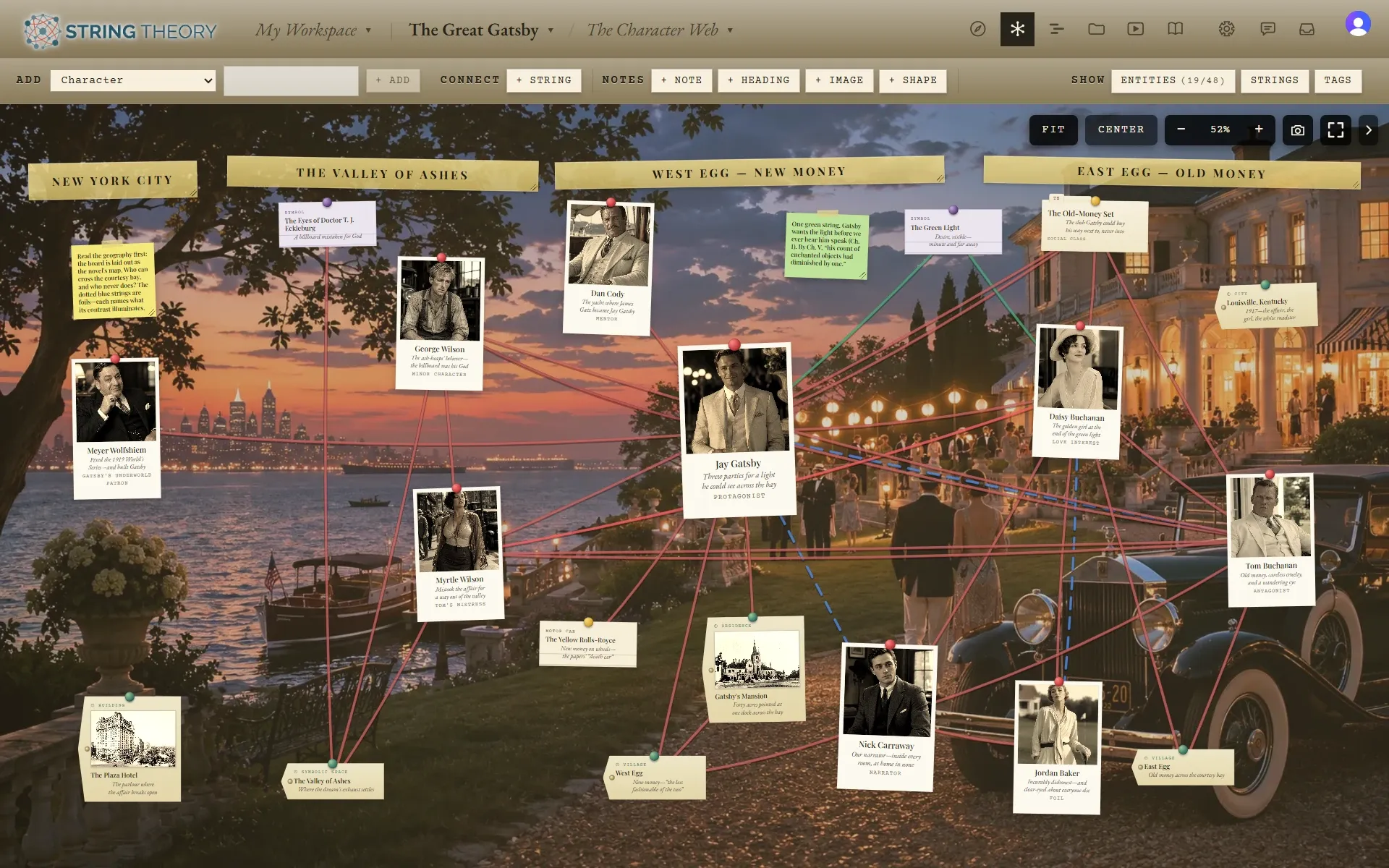
The Story template is for people writing fiction. This one is for taking apart a work that already exists, which is a different job with a different vocabulary. Its cards read Character, Setting, Object / Symbol, Scene / Plot point, and Theme / Device, and the strings between them say symbolizes, foreshadows, foil of, develops, and alludes to. Nothing about the tool changes. The board is the same corkboard, with the questions an English class actually asks written on the cards.
Every claim says what it rests on
The template’s signature field is called Basis, and it appears on every card. Each claim is marked as Stated in the text, Implied, or My interpretation, and there is a Textual evidence box beside it for the passage or the page. “Nick is from Minnesota” is stated. “Nick is drawn to Gatsby despite disapproving of him” is implied. “Nick is in love with Gatsby” is an interpretation, a defensible one with a body of criticism behind it, and the field exists so a reader can make that claim honestly instead of smuggling it in as fact. A board where everything is marked as stated has not been read carefully. A board where everything is interpretation is not an analysis of this particular book.
Characters carry the classroom’s vocabulary
A character card asks for a Role (Protagonist, Antagonist, Foil, Narrator, Love interest, Mentor), a Characterization in Forster’s terms (round or flat, dynamic or static), what they want, how they change, and where they first appear. The strings speak the same language. When one character is a foil of another, the string asks what the contrast illuminates, and the answer goes on the string itself, where a grader or a book club can read it. Knows is almost always the wrong string. Admires, wants, betrays, and foil of each say something.
Symbols are argued into themes
Symbols and themes are both cards, and the rule that makes the board an analysis is that they have to be connected. A symbol strung to a theme with symbolizes, develops, or embodies carries a Significance note saying how, in one sentence. A symbol with no string is a list entry. Passages are cards too, quoted exactly and cited to the chapter, so the evidence sits on the board beside the reading it supports. The Gatsby demo keeps them on a second board of their own, with the themes and essential questions across the top and the cited passages beneath.
Two orders of telling
Every scene card records where in the text it appears and when it happened in the story’s world, and those are different questions. Switch to the Timeline and the board reorders itself by story date. Gatsby and Daisy’s courtship in Louisville, which the reader meets in Chapter 4 secondhand from Jordan, jumps to the front, five years before the novel opens. Fitzgerald could have told it in order and chose not to. A foreshadows string from an early scene to a late one makes the setup a physical thing on the wall, and cutting either end tells you what else just broke.
Sources, without the last-night scramble
Works, editions, and outside sources are cards with authors, dates, and identifiers. Every image carries a license, an attribution, and a link back to where it came from. The Sources view assembles all of it into a bibliography as you go, so there is nothing to build the night before it is due. One limit to know up front: it renders a readable one-line citation per source, not a formatted MLA or APA entry. If the department requires MLA 9, the list gets reformatted by hand.
For teachers: a ready-to-teach unit
The Great Gatsby character map is a five-period unit written in Understanding by Design, mapped to Common Core (with TEKS, Florida BEST, and Virginia SOL equivalents), with a rubric, formative checks, and the media, citation, and AI ground rules a school will ask about before the first image goes on a board. The demo board on this page is its worked exemplar. It is a model rather than an answer key, and its readings are meant to be argued with.
Your first board in 15 minutes
- Create a project and pick Literary Analysis.
- Add the protagonist, the antagonist, and the narrator. Give each a Role and fill in what they want.
- Set a Basis on each field you filled in, and be honest about which ones are your own reading.
- Add one symbol and one theme, then string them with symbolizes. In the Significance box, say how in one sentence, without using the word “represents.”
- Add three scenes with where in the text and when in the story’s world.
- Open the Timeline. If the story is told out of order, you can see it now.
What it isn’t
Nothing here reads the book for you. There is no summary, no generated analysis, and no field the tool fills in on its own; a Basis of My interpretation is a claim you have to defend. It is the companion to the Story template rather than a replacement for it, and a novel in progress belongs over there. The Sources view keeps your citations honest and readable, but it does not format them to a style guide.