
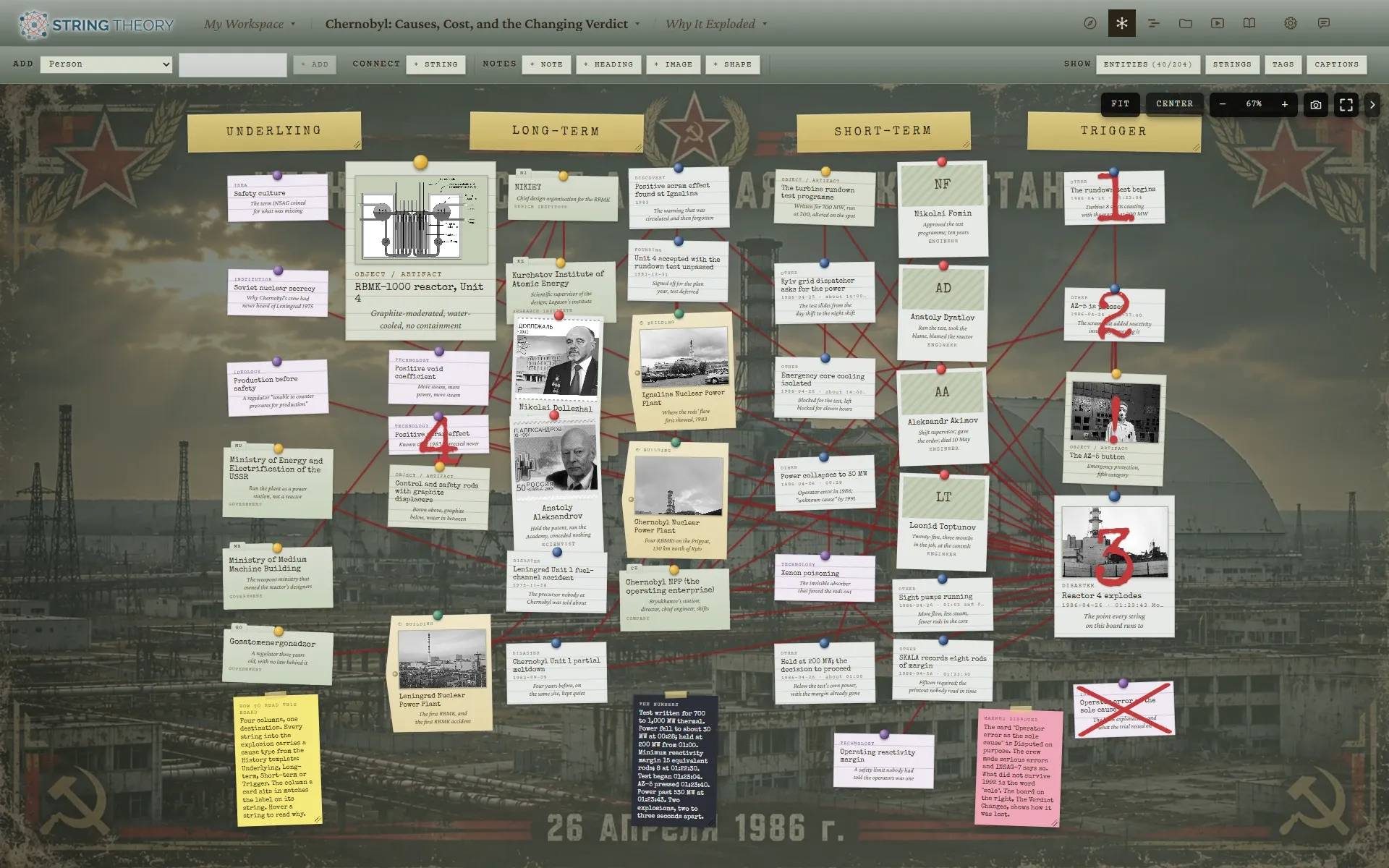
The past as a chain of causes
Most history assignments ask the same question in different clothes: why did this happen, and how do we know? The answer is a web. People make decisions inside institutions, under pressures that took decades to build, and the event everyone remembers is only the last link in it. The History template is a string board for that web, for teachers, for students, and for anyone who reads history for fun and wants to see the whole thing at once. It is for real events. If you are taking apart a novel, its sibling, Literary Analysis, is the one you want.
Every cause says how deep it goes
The template’s signature idea is a single field. Every causal string, whether it contributes to, triggers, results in, or results from, carries a cause type: Underlying, Long-term, Short-term, or Trigger. That is the vocabulary history rubrics already grade in, so “string your causes and label their depth” works as an assignment as it stands. On the Chernobyl project’s Why It Exploded board, every cause strung to the explosion is labeled this way, and the cards sit in four columns that match their labels, so the geometry and the data say the same thing. The relationship picker leads with Cause & effect, because that is usually the string you are about to draw.
Sources are allowed to disagree
History is mostly an argument about evidence, and the template makes the argument visible. A report documents an event, a later finding contradicts an earlier one, and two independent investigations corroborate each other. In 1986 the official account blamed the Chernobyl operators. By 1992 the IAEA’s own updated report had shifted the weight to the reactor’s design, and on the board that reversal is a single string from one report card to the other. Two chronicles that tell different stories about the same battle work the same way: two cards and a string between them, which is historiography drawn as geometry. The 2019 HBO series is a Source card too, since most of a class has seen it, and its strings show where it departs from the record.
Every card says what it rests on
Each card carries a Basis: Documented, Inferred, Disputed, or Legendary. “The three divers died” is a story repeated for decades, and on our board it is marked Legendary, because all three men survived the operation. The long-term death toll is Disputed, with the competing estimates as Source cards strung to each other. A board where every card is Documented has probably not looked hard enough, and the Legendary cards are often the most useful ones to teach from.
The rest of the template is built for the past as well. People have an “also known as” field for regnal names, epithets, and transliterations. Rulers get rules, succeeds, and deposes strings with dates on the string itself, and groups record when they were founded and when they ended. Mark a string as past and it reads that way: deposed, ruled, was party to.
Dates the way historians write them
A date field takes what a history book prints: 18 June 1815, 323 BCE, c. 1347, 1205–1210, spring 1815, before 1200, and 1066-10-14 Julian. At the other end of the scale, an event can be dated to the second, which is what the night of the Chernobyl explosion needs. Set a story start and everything earlier folds into the Timeline’s backstory band, which on that board is the long-term causes, from the 1975 Leningrad accident onward. Give a place its latitude and longitude, pasted straight from Wikipedia, and the Navigator pins it on a real map.
Your first board in 15 minutes
- Create a project and pick History.
- Add the event your unit is about, with its date. Mark it Primary.
- Add four causes as cards, one of each depth: something underlying, something long-term, something short-term, and the trigger.
- String each one to the event with contributes to and set its cause type. If two causes seem to be the same depth, that’s a good argument to have.
- Add two sources from the Sources view, and string each one to the event with documents. If they disagree, add a contradicts string between them.
- Set a Basis on every card, and be honest about which ones are only Inferred.
- Open the Timeline. The causes are now in order, and the gap between the long-term ones and the trigger is the lesson.
What it isn’t
The History template holds your research; it doesn’t do it. There is no built-in historical content, no fact-checking, and nothing that fills a card in for you, so a Basis of Documented is only as good as the source you strung to it. The Sources view lists citations readably, but it does not format them to MLA or Chicago. Dates cover BCE, circa, ranges, and the Julian calendar, but not Islamic, Hebrew, or regnal dating. And it isn’t a genealogy tool: family of is a string you can draw, but the app doesn’t build family trees.