
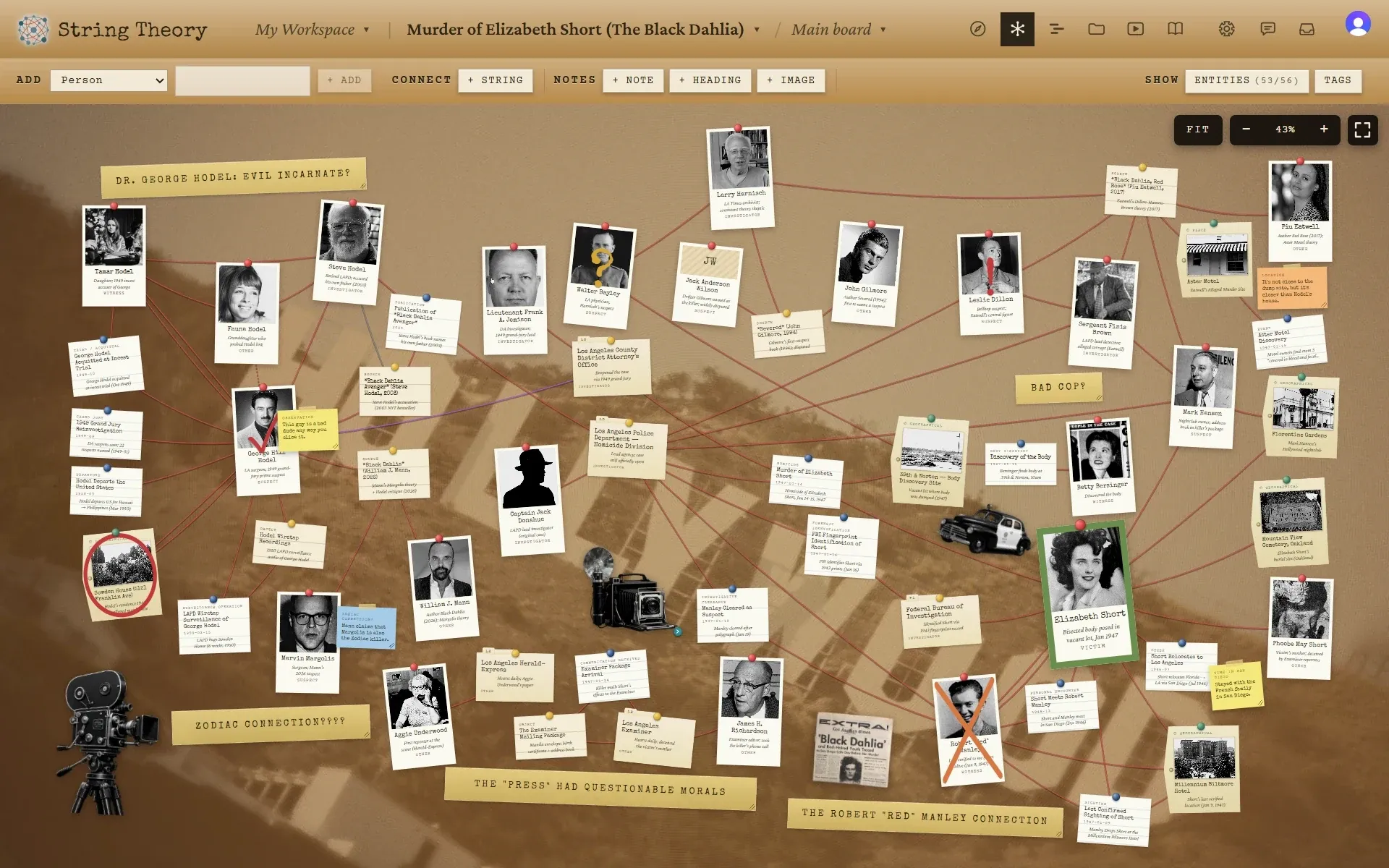
The wall from every detective show, made real
You know the wall from television: photographs, index cards, and red yarn. It shows up in every detective show because it genuinely works. A case is made of people, places, evidence, and events, and the answer usually hides in the connections between them, which is exactly what a wall of string makes visible. The Crime template is that wall, with the parts television leaves out. The cards ask the right questions, the strings remember why you drew them, and nothing falls off when you bump the desk.
Confidence is a field, not a feeling
The template’s signature habit is a small one. Every card carries a confidence rating: Verified, Unverified, or Speculation. The board asks you to choose one every time you add something, and it never lets you skip the question. Two years into a cold case, the difference between “the landlord said so” and “the coroner’s report says so” is the whole investigation. A board that records that difference can argue with you honestly when a favorite theory turns out to rest on three Speculations in a row.
The strings carry their own weight too. “Knew” is a fine place to start, but the template asks better questions: who was where and when, who suspected whom and on what basis, whose alibi covers which hours. Mark a relationship as over and it reads in the past tense everywhere on the board.
The views are the method
Pin the cast on the String Board and you can feel the shape of the case. Switch to the Timeline and the same facts become a sequence, where the gap between the last confirmed sighting and the discovery is suddenly the whole story. Open the Navigator and the case becomes geography: real pins on a real street map, with the route between them making an argument of its own. The Dossier holds the long reads. The Media gallery is the evidence room, holding the photos, clips, podcast episodes, and news pages, each with its source attached.
Your first board in 15 minutes
- Create a project and pick Crime.
- Add the victim, two suspects, and a witness. A name and a photo are enough to start.
- Add the central event with its date, and the place where it happened.
- Draw your first strings: who was present at the event, who knew whom.
- Set a confidence on each card. Be honest about it: Speculation is allowed, and that is the point.
- Open the Timeline. Your case is already a story.
What it isn’t
This is a hobbyist’s wall, built to be fun, for the cold-case reader, the podcast team, and the murder-mystery night. It is not professional forensic or intelligence software. It doesn’t scrape databases or find suspects for you, and it won’t solve the case. What it does is show you what you actually know, which is how you might.