
The stuff that falls out of your head between sessions
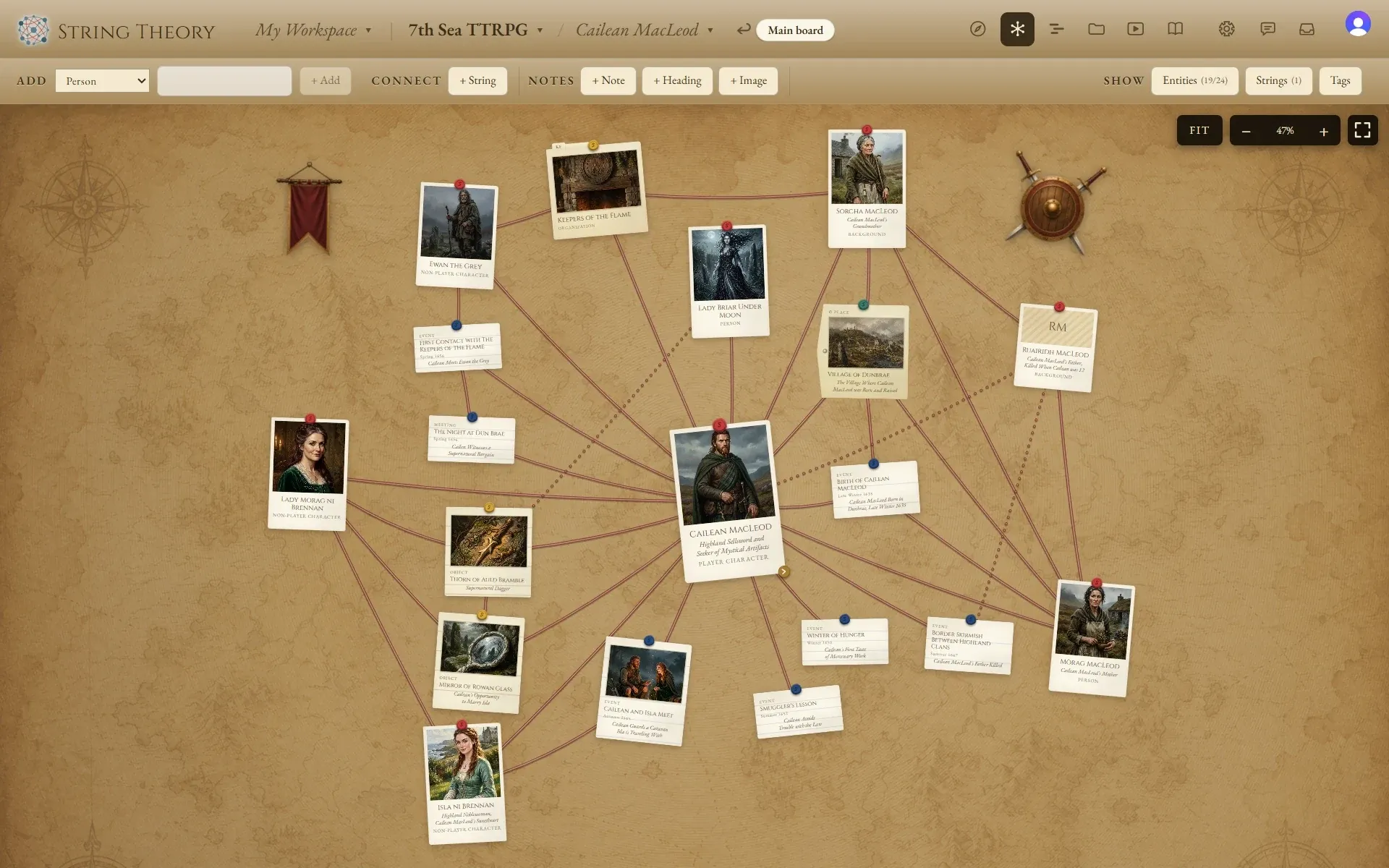
It’s session eight, and a player asks the innkeeper’s name. You improvised him in session two, gave him a limp and a grudge, and never wrote any of it down. A virtual tabletop won’t help you here, because it is built for the table itself rather than the weeks between sessions, and a wiki tool will happily swallow your whole week. The Campaign template is the third thing: the GM’s working memory. It holds the NPCs and what they want, the factions and their secrets, the party, the sessions, and the threads between all of them.
NPCs carry what you actually forget
Every character card asks what they want, their flaw, and how they talk. That last one is the accent-and-mannerism note every GM scribbles somewhere and loses. Whether a character is a PC or an NPC is just a role, and a PC’s card records who plays them. The strings are the campaign itself. A knight is sworn to a house, a cultist worships something better left unnamed, the party quests for the artifact, someone owes someone else a life-debt, and a bounty hunter hunts one of the PCs.
Two clocks, honestly kept
A campaign runs on two calendars, the world’s and the table’s, and the template keeps both. An event records when it happened in the world, in your setting’s own reckoning and with your own unit (“1656 AV”, if that is how your world counts), and the real date your table played it. The Timeline reads the world’s clock. Everything before the story start folds into a backstory band, so the founding of the kingdom doesn’t crowd out the campaign.
Half of any campaign is invented at the table, and some of it gets quietly undone afterward, so everything carries a Canon status: Canon, Planned, Improvised, or Retconned. That is the only honest taxonomy the hobby has.
Stat blocks come along without being parsed
Paste a stat block from any system into the stat-block field and it renders as clean text beside the strings. The character sheet or the monster page can be attached as a PDF or an image. If your table genuinely wants STR and DEX as numbers, add them as custom fields. String Theory keeps the sheet next to the story and never tries to do your math: one template, any system.
Your first board in 15 minutes
- Create a project and pick TTRPG Campaign.
- Add one PC (and who plays them) and the NPC your players ask about most.
- Fill in the NPC’s what they want and how they talk. That is most of next session’s prep.
- Add a faction and string who is sworn to it, and who is lying about that.
- In Dates & Timeline, switch to your world’s calendar and name the unit.
- Add last session as an event. The campaign log has begun.
What it isn’t
There are no dice, no rules content, no computed stats, and no system packs. There is no “D&D 5e template” either, and that is deliberate: the moment this tool computes a modifier it becomes a bad virtual tabletop instead of a good memory. It doesn’t connect to Roll20, Foundry, or D&D Beyond. It lives alongside them. One honest caution about public boards: a PC card can record who plays them, so if you publish a board for the whole internet, use handles, or share it to named people only, which is what that mode is for.